Defense Geospatial Information Agency "Division General Constantin Barozzi"
Ministry of National Defense


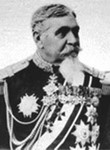
Colonel – 1870-1877; 1879-1882 - Head of the Scientific War Depot
Colonel - 18.08-20.10.1877 - Head of the Operations Corps Staff
Brigadier General - 1877-1879 - General Director in the Ministry of War
Major General - 23.03.-12.11.1888 - Minister of War
Major General - 01.10.1895-01.10.1898 - Chief of the General Staff
Constantin Barozzi (or Barozi) was born on October 14, 1833, in Slatina, Olt County (at that time, Romanați County), in a family of intellectuals (Alessandru and Ralita).
On April 7, 1850, he became a student at the Military Officer School in Bucharest, where he appeared under the name "Baruti" or "Barutzi," and graduated on April 7, 1856, as the third of the 26 graduates, being promoted to the rank of second lieutenant.
On December 20, 1859, he was sent to the Geographical Institute in Vienna to further perfect his professional training in the study of geodesy.
Between 1860 and 1870, he was first a "repetitor" (teaching assistant), then a professor of fortifications, and later became the director of studies, deputy director, and director of the Military Infantry School in Bucharest.
In 1861, following the approval of the Minister of War (No. 2251 from May 5 of the same year), he married Elisa Odobescu, with whom he later had a daughter, Constanța – who would later (1886) become the wife of Gheorghe Iannescu, a future brigadier general and director of the Army’s Geographical Service.
In 1870, he was appointed head of the Scientific War Depot.
Under his exceptional leadership, the "Depot" began in 1873, in northern Moldova, the creation of the country's topographic map at a scale of 1:20,000, using rigorous methods.
Regarding these works, Barozzi, who had reached the rank of colonel, presented in 1874 to the Minister of War, Brigadier General I. Em. Florescu, a report (No. 129 from November 17), entitled "The Beginning of the Country's Map in 1873, Using Scientific Methods," which was actually a true specialist course based on the scientific information of the time and the practical experience gained from the ongoing geodetic and topographic works, thus defining the first military geodetic concept in Romania.
During the War of Independence, he held the position of chief of staff of the Operations Corps across the Danube (from August 18 to October 20, 1877), and then the position of general director in the Ministry of War until March 1879, when he returned as head of the War Depot.
In 1883, he was appointed commander of the active division in Dobrogea and promoted to the rank of brigadier general. In 1892, he was advanced to the rank of major general ("adjutant major general").
Due to his remarkable qualities, Constantin Barozzi held the highest positions in the military hierarchy: Chief of the General Staff of the Army from 1895 to 1898, and Minister of War from March 23 to November 12, 1888.
In 1876, he was elected vice president of the Royal Romanian Geographical Society and became an "honorary member" of the Romanian Academy in 1906.
On November 12, 1888, he was appointed "general adjutant, chief of the Royal Staff," and in May 1892, he became the commander of the 3rd Army Corps.
On April 1, 1895, he resigned from the army and moved to the reserve. Starting in November 1895, he was reactivated and appointed head of the General Staff of the Army.
In April 1907, he was retired due to age limits.
Constantin Barozzi, one of the top personalities of the Military Topographic Directorate, shone through his professionalism, scientific demeanor, and dedication.
He passed away in 1921, at the age of 88.
His personality was appreciated at the highest level when King Ferdinand I placed a wreath of flowers upon his death, with the mention: "To Major General Adjutant Constantin Barozzi, gratitude, remembrance."