Defense Geospatial Information Agency "Division General Constantin Barozzi"
Ministry of National Defense

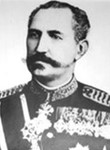
Colonel - 1883-1886 - Chief of the 2nd Section of the General Staff
Brigadier General - 1894-1895 - Minister of War
Brigadier General - 1898-1900 - Chief of the General Staff
Constantin Poenaru was another prominent figure in Romanian military topogeodesy and the Romanian Army during the second half of the last century.
He was born on April 8, 1842. He graduated from the Military School of Artillery and Engineering on July 1, 1861, with the rank of second lieutenant and was assigned to the 4th Artillery Regiment. He then attended the courses of the Military Officers' School and the Staff School in Paris.
After being promoted to lieutenant on August 30, 1863, and to captain on October 2, 1867, in 1869, he was "attached" to the War Depot as an operator.
In the summer of 1870, Captain Constantin Poenaru participated in the work of the "Danube European Commission" for the surveying of the Danube from Brăila to Sulina, resulting in the map of the Danube Delta.
After completing the work, Constantin Poenaru presented a technical memorandum, called a "momerandum," structured into four parts, showing with great clarity how the fieldwork was carried out.
On January 1, 1872, he was promoted to the rank of major.
He participated in the War of Independence as the commander of the 8th Infantry Regiment in the third battle of Plevna (August 30/September 11, 1877) and during the encirclement and blockade operations of Plevna and Vidin.
On April 1, 1877, he was appointed head of the Operations Section in the General Staff of the Great General Headquarters.
At the end of the war, he received military orders and medals: "The Star of Romania" in the rank of officer, 3rd class, and in the rank of grand officer, "The Crown of Romania" in the rank of commander and grand officer, as well as the Russian order "St. Anna."
On April 8, 1880, he was promoted to the rank of lieutenant colonel.
On February 1, 1883, he was appointed head of Section II ("Study of geographical issues and military topography") in the Great General Staff and a professor of military art at the Application School for special arms.
On January 1, 1886, he was promoted to the rank of colonel, and three months later, he was appointed commander of the Special School of Artillery and Engineering and professor of military art.
On October 1, 1887, he was promoted to deputy chief of the General Staff and head of Section III ("Work and maintenance of the country's map") in the Great General Staff.
On October 1, 1889, he was appointed director-general at the Ministry of War and professor of Infantry Tactics at the War School.
Meanwhile, on December 1, 1891, he was promoted to brigadier general.
On June 12, 1894, due to his exceptional qualities, he was appointed Minister of War, a position he held from June 1894 to October 1895.
Together with General Lahovari, he took measures to complete the military reform program initiated between 1879 and 1882, thus contributing to the preparation and implementation of the Law on the organization of the General Staff on May 6/18, 1895.
On October 4, 1894, he was replaced from the position of Minister of War and appointed divisional commander, a position he held until October 1, 1898, when he was appointed Chief of the General Staff. He held this position until April 7, 1900, when he was replaced and became a member of the Advisory Committee of the Ministry.
On the same day, April 7, 1900, he was promoted to the rank of major general. A year later, on April 1, 1901, he was placed in reserve and retired.
He passed away in 1912 at the age of 70.