Defense Geospatial Information Agency "Division General Constantin Barozzi"
Ministry of National Defense


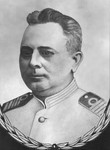
CORNELIU BUCHHOLTZER
Rear Admiral - 1934-1938 - Director of the Military Geographic Institute.
CORNELIU BUCHHOLTZER was born on April 27, 1880, in the city of Slatina, Olt County.
He attended high school in Slatina, and after graduation, he enrolled in the Military School of Artillery and Engineering, which he completed on July 1, 1900.
After graduating from the military school, he was promoted to the rank of second lieutenant and assigned to the 1st Engineer Regiment.
Recognizing his exceptional value, in 1903 he was sent to the Naval Applications School, where he graduated first, with the “future officer distinction for the navy.”
From November 1901 until October 1909, he alternated between the Black Sea Division and the Danube Division. In 1913, he passed the commander’s exam, where he ranked first and was transferred, starting in April 1913, to the monitor "Lahovary" (he was also mobilized there from June 23 to August 31, 1913).
In the officer’s memorandum, under the "missions" section, it is noted that, between August 22 and September 8, 1913, he carried out missions abroad.
In the following period, until 1918, he served successively at the Naval Command, the General Depots, the Danube Division, and again at the General Depots.
In 1918, he was replaced from his position as head of the Operational Fleet (see reasons in Section III - note). Between 1918 and 1930, he held several positions, changing them frequently: captain-commander and commander at the Maritime Prize Court (1919-1920), commander at the Naval Schools (1920), Maritime Naval Force (1924), Naval School (1926), Maritime Depot Corps (1928), and director-commander at the Military Education Directorate (1930) in the Ministry of Defense.
Starting in April 1931, he was the director-commander of the Navy Directorate in the Ministry of Defense, where, on May 10, 1931, he was promoted to the rank of rear admiral. From October 1933, he served as the director-rear admiral at the Royal Navy Services.
On February 6, 1934, Rear Admiral Corneliu Buchholtzer was appointed director of the Military Geographic Institute in Bucharest (reorganized in 1930).
From the moment of his appointment, Rear Admiral Corneliu Buchholtzer proved to be an excellent organizer and took a series of measures to improve the institute’s activities.
The most substantial measures included the construction of a new pavilion for the offices and workshops of the Cartographic Reproduction Section and equipping them with the most modern machines.
He supported and succeeded in setting up a new map storage facility for the "war stock" on the ground floor of a pavilion of the Army’s Subsistence Depot at Obor, as well as equipping the institute with a complete field campaign photogrammetric kit, which, in addition to the photogrammetric section, included geodetic equipment and map printing machines, arranged in field kits, to be used wherever necessary.
Additionally, for the first time in practice, stereographic projection was applied, and on average, 30 topographic plans were produced per year using phototopographic methods.
In 1937, he was placed in reserve, but due to his qualities, he was retained at the institute's leadership for another year as a specialist.
He was permanently retired in 1938 at the age of 58.
He passed away in 1941 at the age of 61.