Defense Geospatial Information Agency "Division General Constantin Barozzi"
Ministry of National Defense


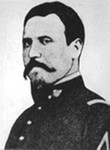
GEORGE SLĂNICEANU
Lieutenant - 1859-1862 - Head of the 2nd Section of the General Staff
Lieutenant Colonel - 1867-1868 - Head of the War Depot
Colonel - July 24, 1876 - April 1, 1877 - Minister of War
Colonel - April 27, 1877 - August 18, 1877 - Head of the General Staff
Brigadier General - 1878-1881; 1882-April 12, 1883 - Head of the General Staff
Brigadier General - 1880-1881 - Minister of War
Brigadier General - 1884 - Cavalry Inspector
George Slăniceanu (in some texts referred to as Gheorghe, but according to "The Officer's Leaflet," the name used in this work is George – note) was born on April 23, 1835, in Bucharest.
On April 7, 1854, he was enrolled as a student at the Military School for Officers in Bucharest, which he graduated from in 1856 as the top of his class.
On April 7, 1856, he was appointed to the 1st Infantry Regiment, holding the rank of second lieutenant.
On May 8, 1858, the "Engineering Bureau" (Geniu Bureau – note) was established, and George Slăniceanu was part of it. The mission of the bureau was to continue the work on the maps started by Marshal De Fligely. It is worth noting that Slăniceanu, like Constantin Barozzi, had been part of the fieldwork team for the marshal and had completed the "primary and secondary triangulation networks."
He was promoted to the rank of lieutenant on December 20, 1859, and after the issuance of the Daily Order No. 83 on November 12, 1859, he became the first head of the 2nd Section of the General Staff (the initial name of what would later become the Military Topographic Directorate).
He was promoted to the rank of captain on June 6, 1862, and was appointed to the Engineer Battalion, the structure within the General Staff that briefly took over the responsibilities of the Map Depot.
On May 22, 1864, he was promoted to major, and on October 2, 1867, to lieutenant colonel. On January 1, 1870, he was promoted to colonel.
On July 24, 1876, he was appointed "Minister of War," a position he held until April 1, 1877.
He participated in the War of Independence in 1877-1878 as the Chief of the Romanian Army General Staff during its military operations on the Plevna front.
He commanded the assault detachment of the Rahova fortress and led the Reserve Division in the battles around the Vidin redoubt.
In July 1877, he was included in the Romanian delegation led by Prime Minister I.C. Brătianu for negotiations with the Russian side.
On August 28/September 9, 1877, he participated in the War Council at Radeniţa, where the general assault of August 30/September 11, 1877, was decided.
He was awarded the "House of Hohenzollern Honor Cross," 3rd class, conferred by "His Royal Highness Prince Carol of Hohenzollern-Sigmaringen," and from the Russians, the "Order of St. Stanislaus," 2nd class with plaque, conferred by "His Majesty Tsar Alexander II, Emperor of All Russia."
On July 29, 1878, he was appointed Chief of the General Staff of the Army, and in 1879, he was promoted to the rank of Brigadier General.
He served as Minister of War during two periods: April 28, 1880 – April 9, 1881, and April 10 – June 8, 1881.
He was a participant, alongside other Romanian specialists, in preparing the text of the 1882 Military Command Organization Law, which effectively created a General Staff as a distinct body within the Ministry of War.
He was appointed Cavalry Inspector in 1884.
George Slăniceanu conducted fruitful theoretical work, particularly in the period leading up to the War of Independence: "Railroads considered as military operation lines," "The Soldier’s Manual – course of study, tactics, and strategy."
He was one of the first military authors to specifically address the theoretical problems of tactics and strategy, paying great attention to the geographical aspects of both components of military art and the distinction between them.
In addition to strategy and tactics, he considered there to be a third aspect, which he called "the politics of war."
His significant theoretical contribution was creating an early synthesis between French military art (Jomini, Napoleon) and German military art (Clausewitz), focusing on adapting them to national military traditions.
He passed away on January 12, 1885, in San Remo.