Defense Geospatial Information Agency "Division General Constantin Barozzi"
Ministry of National Defense

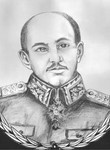

IOAN PAVELESCU
Brigadier General - 1916-1919 - Head of the Geographic Service of the Army in the Armies Zone and Head of the Geographic Service of the General Staff.
IOAN PAVELESCU was born on January 1, 1869, in the city of Ploiești.
He attended the Military School in Iași, starting on July 10, 1884, and graduated in 1888.
From July 16, 1888, until 1890, he attended the Officer School in the special arms section and, upon completing the courses, was promoted to the rank of second lieutenant. Between July 16, 1890, and 1892, he attended the Special School of Artillery and Engineering.
After graduation, he was assigned to the 2nd Engineer Regiment.
He was promoted to the rank of lieutenant in 1893.
Between 1893 and 1895, he was in charge of fortification work at the FNG fort and the Fortress of Bucharest.
On April 8, 1895, he was appointed as a professor of military geography and topography at the "Schools of Artillery, Engineering, and the Navy."
He was promoted to the rank of captain on April 8, 1898, and was assigned to the Engineer Service of the 2nd Army Corps.
On October 1, 1899, he was appointed company commander at the Schools of Artillery, Engineering, and the Navy.
On February 20, 1905, he was "attached" to the Army Geographic Service, and from April 1, 1905, he was transferred to the same service.
Starting in 1907, although remaining assigned to the Army Geographic Service, he was appointed professor of topography at the Higher War School.
He was promoted to the rank of major on May 10, 1908.
He continued to be assigned to the Army Geographic Service and was "attached" until 1909 to the 1st Army Corps, Engineer Service.
On April 1, 1909, he returned to the Army Geographic Service and was appointed head of the Topographic Section. At the same time, he was appointed professor of military geography and topography at the "Prince Carol" Higher War Academy.
In 1912, he was appointed as the military geography professor for His Royal Highness Prince Carol, the future King Carol II of Romania.
He participated in the 1913 campaign (the Balkan War), being mobilized to the General Army Headquarters as head of the Topographic Office. In this role, he revised the map of Bulgaria at a 1:100,000 scale in the operational area (over 13,000 km²) and was part of the commission that delineated the Romanian-Bulgarian border.
He was awarded the "Star of Romania," 5th class, and the "Courage and Faith" and "Advance of the Country" medals for his role in the 1913 campaign.
On April 1, 1916, he was promoted to the rank of colonel and appointed head of the Geographic Service in the Army Zones.
By Royal Order no. 9622, in August 1916, during the mobilization of the Romanian Army, King Ferdinand appointed him head of the Geographic Service of the Great General Staff, a structure responsible for organizing and leading the Topographic and Observation Sections at the level of large units.
In November 1916, in just one week, he managed to evacuate the entire Army Geographic Service and relocate it to the Administrative Palace in Iași (still under construction). The service’s assets were estimated at 8 million gold lei at the time and were transported in three train sets, each with 30 wagons.
In these extraordinary conditions, he succeeded in organizing the service in such a way that it could provide the troops with a new type of maps, in conical projection, called “Fire Control Plans.” He also sent two army geographic sections to the front line, 16 divisional topographic sections, and 15 artillery observation sections.
On May 10, 1918, he was promoted to the rank of brigadier general, and on October 28, 1918, he was mobilized to the Great General Staff, remaining head of the Geographic Service of the Army in the Army Zones (the operational part of the service during the war).
Ioan Pavelescu served as head of the Geographic Service of the Army in the Army Zones until 1919.
For his outstanding merits during the war, he was decorated with the following orders: the “Crown of Romania” with swords, in the rank of Commander, the "Legion of Honour" and Officer grade, the “Queen Maria Cross,” and the Russian order “Saint Anne” in the rank of Commander.
He passed away in 1937 at the age of 68.