Defense Geospatial Information Agency "Division General Constantin Barozzi"
Ministry of National Defense


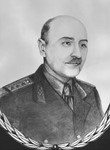
RADU-MIRON BODNĂRESCU
Brigadier General - 1940-1945 - Director of the Military Geographic Institute.
RADU-MIRON BODNARESCU was born on December 4, 1889, in the village of Pomârla, Dorohoi County (currently Botoșani County). After completing high school and obtaining his baccalaureate in 1908, he attended the Artillery and Engineering School in Bucharest.
After graduating from the military school, on July 1, 1910, he was promoted to the rank of second lieutenant and assigned to the 16th Artillery Regiment as an "observer officer," and three months later, he was transferred as a "liaison officer" to the 2nd Artillery Regiment.
In 1912, he graduated from the Special Artillery School, and on October 1, he was assigned as a "liaison officer" to the 18th Artillery Regiment, and a year later, as "officer for research and assistant battery commander" at the 11th Artillery Regiment.
On November 1, 1916, he was promoted to battery commander at the 23rd Howitzer Regiment and participated in all the battles of World War I on the Olt Valley until November 6, 1916, and on the Argeș Valley with the 8th Division until November 20 of the same year, when he was taken prisoner.
He was promoted to the rank of major on December 11, 1918.
He was awarded the "Crown of Romania" Order, Class IV in 1922, and the "Star of Romania" Order in 1928.
Brigadier General - 1940-1945 - Director of the Military Geographic Institute
After contributing to the calculation of the stereographic projection of Romania, with a secant plan at Brașov in 1930, on November 1, 1933, he was promoted to Chief of the Studies Bureau, where he prepared technical studies with competence, showing inventiveness and research skills in the field of optics and mechanics applied to geodetic measuring instruments.
Two of his invention patents (No. 6739 from 1922 and No. 17739 from 1929), concerning the development of beacons and heliotropes for lighting observation points in the angle-measuring process, elaborated a few years earlier, were used for decades.
On October 1, 1935, he was appointed as "Deputy Head of the Geodesic Section," where he coordinated geodetic calculations, especially those for determining the definitive coordinates of points in higher-order triangulation chains that had been previously measured.
On July 1, 1936, he became the head of the Geodesic Section and Inspector, putting in significant and competent effort for overseeing and verifying field measurements, geodetic astronomy, geodetic triangulation, and precise leveling operations.
On November 1, 1937, he was appointed Chief of the Technical Service of the Military Geographic Institute.
Due to the political and military events preceding World War II, three geographical sections were established at the army level, six photogrammetric sections at the corps level, and thirteen topographic sections at the division level. These structures were organized in six train carriages, constituting mobile campaign geographic units.
Later, on November 1, 1940, he was appointed Director of the Military Geographic Institute.
Under his leadership, the Military Geographic Institute demonstrated its capacity to produce military maps under the most difficult wartime conditions.
Thus, starting on July 15, 1943, the map depot of the Military Geographic Institute (about 40 carriages) was moved to Bușteni, and in the first part of 1944, the Cartographic Reproduction Section was relocated to the village of Domnești, the Geodesic and Topographic Sections to the village of Berevoești, and the Cartography School to the village of Stănești, in Argeș County.
He remained in the position of director of the Military Geographic Institute until March 27, 1945, when, for political reasons, he was put at the disposal of the Ministry of War and transferred to the reserve the following day.
He passed away on November 3, 1972, at the age of 83.