Defense Geospatial Information Agency "Division General Constantin Barozzi"
Ministry of National Defense


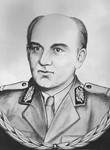
RADU NEGOESCU
Brigadier General - 1946-1947 - Director of the Military Geographic Institute
He attended primary school in Bacău, completed five years of gymnasium in Bucharest, and then attended the Military Technical High School in Iași.
In 1914, he entered the Military School of Artillery and Engineering, graduating on July 1, 1916, with the rank of second lieutenant and was assigned to the 1st Heavy Artillery Regiment.
With this regiment, he participated in World War I, taking part in the fierce battles at Nămoloasa and Mărășești and later in the campaign in the West.
He was promoted to lieutenant on September 1, 1917, and decorated with the Order of "Coroana României," 5th class (1922), and the medals "Commemorative Cross 1916-1918" (1918) and "Victory" (1921).
On August 14, 1919, he was detached to the Army's Geographic Service to attend the Topographic and Observation Section Chiefs School, which he graduated from in 1920. From May 5, 1921, he attended the Special Artillery School in Timișoara, graduating on December 17, 1921.
From April 1922, when he was transferred to the Army's Geographic Service until 1924, he worked as a tachymetric operator for the delimitation of Romania's borders with Hungary. He continued to work as a tachymetric operator for border delimitation until 1924.
In 1925, he was transferred as a geodetic operator to the Geodesy Section. From 1926 to 1931, he participated in the international meridian arc measurement works and the boundary delimitation works with Poland (on the Dniester, 120 km) and Bulgaria.
In 1930, he was decorated with the Order of "Steaua României," 5th class.
From 1931 to 1934, he was promoted to head of the "Boundary Office," during which time he also taught arithmetic, geometry, physics, and chemistry at the Cartography School.
Between 1934 and 1937, he served as deputy head of the administrative corps.
From May 15 to June 30, 1936, he attended the phototopography course, and in January 1938, he was sent to attend the photogrammetry courses at the German company Zeiss in Jena, to improve his knowledge of the new photogrammetric equipment brought to the Military Geographic Institute.
From 1933 to 1939, he contributed to the creation of a series of specialized manuals printed by the Military Geographic Institute.
In April 1944, he was appointed head of the Topographic Section, and on June 5, 1945, he became head of the Geodesic Section.
On August 14, 1946, he was promoted to the rank of brigadier general and appointed Director of the Military Geographic Institute.
Due to "political reasons," on December 29, 1947, he was forced to cease his activity and was put at the disposal of the Ministry of National Defense, after which, on January 1, 1948, he was retired and pensioned.
From February 15, 1948, to January 28, 1950, he was a technical delegate at the Ministry of Foreign Affairs for the delimitation of Romania's borders with Hungary and Bulgaria.
His professional preparation being recognized, he was allowed to teach geodesy as a professor at the Faculty of Land Surveying at the Bucharest Institute of Construction and at the Military Technical Academy, Faculty of Geodesy, where he was head of the Geodesy Department until 1954.
He passed away in September 1973 at the age of 80.