Defense Geospatial Information Agency "Division General Constantin Barozzi"
Ministry of National Defense


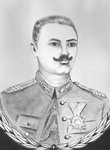
RADU TOROCEANU
Brigadier General - 1919-1925 - Senior Director of the Army Geographical Service
On July 1, 1884, he entered the Artillery Officers' School, which he graduated from on July 1, 1886.
Upon graduation, he was promoted to the rank of second lieutenant and assigned to the 8th Artillery Regiment as a "subaltern officer."
On October 16, 1890, he was "attached" as an assistant professor at the Special School of Artillery and Engineering, where he taught the Military Geography and Topography course, with his base assignment at the 1st Artillery Regiment.
On May 10, 1894, he was promoted to the rank of captain and "attached" as a professor of analytical geometry at the Special School of Artillery and Engineering, with his base assignment initially at the 11th Artillery Regiment and later at the 6th Artillery Regiment.
From April 1, 1899, he was appointed as an officer in the Technical Artillery Corps of the General Staff and soon after, on May 10, 1899, he was "attached" to the Military Geographical Institute.
Here, from July 11 to September 17, 1900, he participated, for the first time in Romania, in determining the astronomical longitude difference between the Potsdam Astronomical Observatory (Germany) and the Military Astronomical Observatory in Bucharest, with the purpose of establishing a direct astronomical link between the two observatories.
By indirect linkage, using measurements between Potsdam and Greenwich (United Kingdom), the longitude of the Bucharest Observatory was determined in relation to the Greenwich meridian.
Astronomical observations were made by two mixed teams: one consisting of Toroceanu and Borass, and the other made up of Râmniceanu and Albrecht, using the method of permutation of operators.
In the first phase, at the Military Astronomical Observatory in Bucharest, Râmniceanu performed observations on the east meridian pillar, while Albrecht observed on the west fundamental pillar. Simultaneously, at the Potsdam Astronomical Observatory, observations were made by Toroceanu and Borass.
In the second phase, Râmniceanu and Albrecht performed observations at Potsdam, while at Bucharest, Toroceanu observed on the east meridian pillar, and Borass on the west fundamental pillar.
From May 1, 1888, to August 30, 1889, he attended the Special School of Artillery and Engineering, and upon graduation, he was appointed "assistant battery commander" at the Engineer Battalion and promoted to the rank of lieutenant.
On February 1, 1901, he was appointed head of Bureau II in the Geodesic Service of the Military Geographical Institute and a full professor of analytical geometry at the Special School of Artillery, where he also taught, as an assistant professor, at the artillery course.
He was promoted to the rank of major on March 15, 1904.
On January 1, 1906, he was appointed "adjutant" at the Royal General Staff, a position he held until May 1, 1912, when he was promoted to the rank of lieutenant colonel and temporarily assigned to command the 12th Artillery Regiment.
On April 1, 1913, he was appointed commander of the regiment. In this capacity, he participated in the military campaign in Bulgaria from June 20 to August 31, 1913.
For his outstanding merits, he was decorated in 1913 with the "Coroana României" Order, 4th Class.
Previously, in 1912, by High Decree no. 2660, he was granted the right to wear the "tifra (belt) and adjutant's epaulet."
On February 1, 1915, he was promoted to the rank of colonel and appointed "director of superior schools" within the Ministry of War, by High Decree no. 6218.
On April 1, 1918, he received the rank of brigadier general and was appointed, in 1919, "director of the Superior Geographical Service of the Army."
He was promoted to the rank of division general on January 15, 1920.
He remained in the position of "director of the Superior Geographical Service of the Army" until December 21, 1925, when he passed away while still in service, at the age of 60.